Introduction
In a world where foundational LLMs are becoming more powerful in terms of reasoning and tool use, the transition to an agentic economy is already underway where agents, powered by agentic frameworks, tool uses and LLMs are becoming an essential to businesses looking to automate and enhance operational efficiency.
However, the sprawling number of agents and agentic frameworks make it hard for agents to verify, communicate and interact with one another.
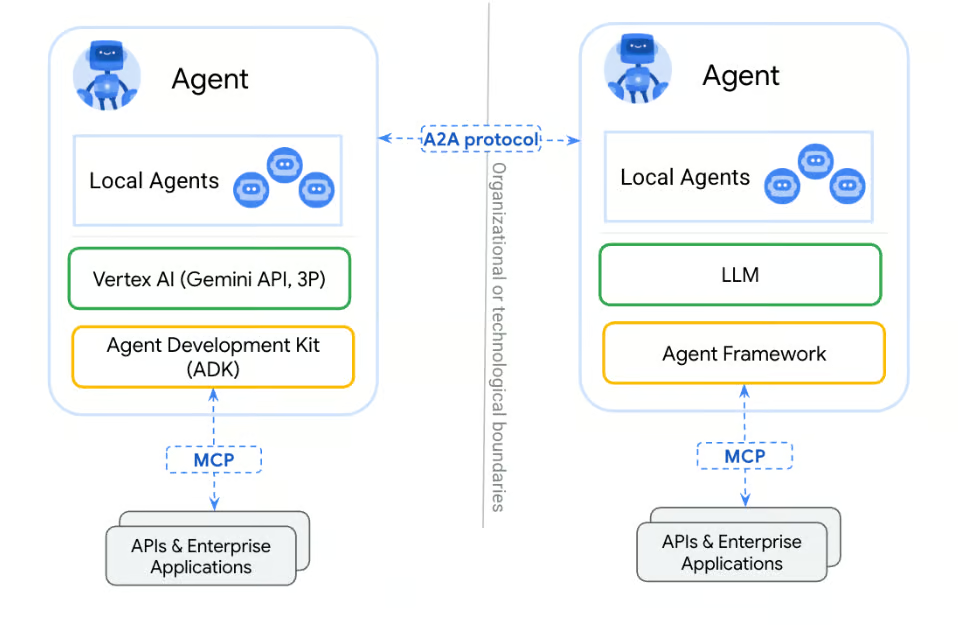
Google has launched their A2A (Agent-to-Agent) protocol which makes it easy for agents to identify and communicate with each other (Agent Card) to execute tasks as long as these agents are integrated with the A2A protocol. This removes a hurdle where agents, powered by different frameworks or vendors, face difficulty in interacting with each other across siloed data systems and applications.
However, against the web3 ethos of censorship-resistance and transparency, Google's A2A protocol falls short in achieving these as it assumes trust between the client agent and server agent. Blockchain delivers an additional layer of transparency and trust through cryptographic proof systems and immutable track record onchain, traits that are increasingly valued by institutions.
With institutional capital increasingly deploying into Ethereum amid regulatory tailwinds, the network now commands more than 60% of all DeFi activity. Ethereum also commands the lion share in the RWA market with 51% and if we include stablecoin, that pushes its market share to 55.8%. This data continues to validate the point that Ethereum has become the preferred layer for institutional capital deployment.
As the agentic economy in web3 matures beyond social and memecoin trading agents to one that supports institutions' onchain strategy, a framework for trustless, verifiable and secure agent communication is essential.
ERC-8004 Architecture
ERC-8004 proposes a framework for agent coordination on EVM chains, consisting of three main components:
Identity Registry
This is the foundational layer where agents register their identity using CAIP-10 standard addresses. The registry maintains agent cards that contain metadata about each agent's capabilities, endpoints, and authentication methods. This enables discoverability and establishes a canonical source of truth for agent identities onchain.
Task Registry
The task registry manages the lifecycle of agent tasks, from assignment to completion. It tracks task status, handles escrow for payments, and maintains a record of all task-related interactions between client and server agents.
Validation Registry
This layer provides 2 main verifications: crypto-economic verification and crypto-verification. In the former, an agent validator can be restaked AVS, a centralized trusted agent or any programmable governance that is able to provide validation. In the latter, TEEs and zkTLS can be used. Future developments could open up new revenue streams for participants in this layer that scale with the significance of these transactions.
How it Works
The workflow of ERC-8004 follows these steps:
- Initialize and register agents to the identity registry. There are 3 types of agents: Client agent assigns task to server agent and provides feedback; Server agent accepts task and feedback; Validator agent validates task, leveraging different trust models.
- Client agent discovers server agent by reading agent cards, then negotiates the job outputs. This negotiation is done offchain.
- When the server agent accepts the job request, it also accepts feedback from the client agent once the task is completed.
- Server agent executes the task and publishes a data hash that commits to all the information needed to re-run the job.
- Server agent then also requests for a validation via ValidationRequest.
- Validator agent watches for these requests and validates using crypto-economic security or crypto verification.
- If successfully verified, the validator agent responds with a ValidationResponse.
- With the ValidationResponse, this trustless setup ensures that payment can be released from escrow for various services executed correctly.
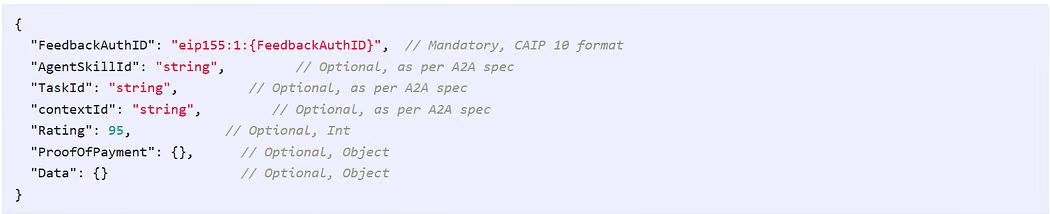
- After seeing the validation, the client agent publishes a feedback attestation that embeds the datahash, participants, 8004-request/response IDs, allowing the results to be queryable.
Payments, attribution, incentives, slashing are not accounted for in ERC-8004, leaving room for design flexibility during and post task execution.
Benefits
With a universal standard for accessing identity, reputation in a secure and verifiable way, ERC-8004 though in its early innings, already demonstrates potential benefits to the broader onchain ecosystem:
- Portable discovery and provenance via an Identity Registry + Agent Cards
- Agent address uses CAIP 10 standard ensures agent identity can be referenced seamlessly across chains
- Pluggable trust models: flexibility with TEE attestation proofs, zkTLS proofs and cryptoeconomic security
- Attestation layer neutrality
- Light onchain footprint balances gas fees while allowing for flexibility in reputation algorithm, validation and storage protocols
Key Beneficiaries
Now with an onchain authorization and validation hook driven by ERC-8004, agents are able to interact trustlessly with each other on EVM chains. Several types of protocols are likely to be key beneficiaries:
Restaking services
ERC-8004's Validation Registry gives restaking networks a neutral hook to prove that an agent's job was checked (or challenged) and to post the outcome. Restaking network like EigenCloud can route validations through their crypto-economic model via an AVS. Slashing will be governed by each AVS.
TEEs and proof systems
ERC-8004 explicitly supports a crypto-verifiable trust model: agents run tasks in TEEs (e.g., Intel SGX-based TEEs) and/or attach ZK proofs; validators then post a ValidationResponse that others can verify. In practice, TEEs give fast execution with remote attestation, while zk-coprocessors make those claims succinct and chain-verifiable—ideal for model inference checks, confidential data use, or re-running heavy computations off-chain.
Use cases I am excited about:
- Crypto deep research agents for specialized sectors
- AI crypto hedge funds, where agents can be hired based on historical track record of automated DeFi strategies
- Onchain credit ratings and automated credit origination based on these ratings
- Specialized agent scoring services
- Conditional milestone payouts for the gig economy
Conclusion
Ultimately, ERC-8004 marks a noteworthy development in the agentic journey through establishing a trustless layer for AI-agent coordination on EVM networks. Just like how MCP created a universal framework for accessing tools, and A2A built a universal communication layer for web2 agents to interoperate with one another, ERC-8004 serves as a blueprint to unlock new revenue streams and enhance user experience through trustless, interoperable agent-to-agent coordination using Ethereum.